Site Design — Turn Your Model into a Scalable Facility
Welcome to this guide on building a modern cannabis cultivation facility. A recent Colorado facility experienced a costly month-long shutdown due to non-compliance with ventilation rules, highlighting the need for thorough facility design to prevent disruptions. (Colorado Air Compliance Tracking and Inventory System, n.d.) Effective facility design goes beyond drafting blueprints; it establishes a scalable, compliant, and efficient operation. A comprehensive facility plan streamlines daily operations, supports quality assurance, and ensures compliance from the outset.
To navigate these challenges effectively, it’s essential to start with a clear understanding of the unique constraints faced by cannabis facilities. Early and calculated planning can help avoid costly redesigns, delayed approvals, or operational downtime. In this extensive guide, we will first explore the critical strategic decisions you’ll encounter, then delve into key infrastructure, regulatory considerations, and best practices. Together, these elements lay the foundation for a high-performing cannabis cultivation environment designed for prolonged profitability. By integrating sustainable practices—such as energy-efficient systems and water conservation—facilities can achieve both environmental stewardship and long-term financial success. This guide underscores that strategic, green facility design is more than compliance: it is an investment in ecological and economic returns.
BLOG MENU
Cannabis Cultivation Facility Design: Your Blueprint for Success
1. With this context, we will examine why expert facility design is essential for success in the cannabis industry.
Designing a cannabis cultivation facility is complex and requires both technical and creative approaches to address challenges such as temperature fluctuations, leaf curl, and mildew odor. As the industry evolves and regulations change, careful planning is necessary to balance compliance, sustainability, and efficiency. Since each facility is unique, making informed decisions early is essential.
A well-designed facility enables staff to work efficiently and ensures plants progress smoothly through each stage, reducing issues and supporting long-term success. Features such as separate rooms, controlled access, and logical movement paths demonstrate regulatory preparedness and simplify inspections. Proactive planning also protects your investment by minimizing costly changes and delays.
2. Once the importance of strategic design is clear, the next step is making foundational choices about your facility's physical structure.
The first major decision in selecting a stable, controlled growing environment typically involves three primary options:
- Building a new indoor grow facility.
- Growing in a cannabis cultivation greenhouse.
- Retrofitting an existing warehouse.
A report from 2023 shows that indoor cultivation remains the most common approach, with 63 percent of participants growing indoors and 31 percent using greenhouses. (2023 State of the Cannabis Cultivation Industry Research, 2023) The best facility type for your operation still depends on your budget, scale, and local environment.
A. Retrofitting a Warehouse
Retrofitting a warehouse can be highly profitable when approached with the right expertise, offering an extended growing season and greater environmental control. Key considerations include: Structure Condition: Assess existing elements such as building proportions, column grids, exits, and plumbing facilities. Engage a structural engineer to inspect for deficiencies and contaminants, including asbestos, lead paint, and mold, to prevent high-cost repairs and maintenance issues.
Ceiling Height: Facilities with higher ceilings (10-14 feet) are often sought to ensure adequate space between equipment (lights, sprinklers) and crops. (18 Tips to Help You Convert a Building into a Cannabis Cultivation Facility, 2025)
Drainage System: Proper storm water drainage is essential to protect the building’s foundation, particularly for industrial sites with flat roofs.
Utility Services: Existing utilities may not meet cultivation requirements. Selecting a site with appropriately sized energy, water, sewer, and drainage infrastructure can significantly reduce operational and construction costs. According to Cannabis Grow Facility Design 101, Part 1, a cannabis cultivation facility of about 10,000 square feet might require significant electrical infrastructure, as power needs can reach approximately 80 watts per square foot for grow areas. (Electricity Usage Reporting Requirements, 2025) Estimating annual energy use and related CO2 emissions is important for understanding both operating expenses and environmental impact. Implementing energy-efficient systems reduces the facility’s carbon footprint and supports sustainability goals.
Future-proof Planning: Consider sites with potential for expansion and ensure new structures can be integrated with existing layouts to limit operational inefficiencies.
B. Building a Cannabis Cultivation Greenhouse
Cannabis greenhouses are increasingly popular due to their sustainability, practicality, and flexibility, combining the benefits of outdoor and indoor cultivation. Successful greenhouse operations require understanding how natural and engineered systems interact to create optimal plant environments. For example, the Hybrid Vail Greenhouse addresses snow load with its peak-style design, while the Venlo Greenhouse manages high humidity with its airtight structure. Both offer security features to prevent intrusions. Aligning these solutions with specific operational needs helps select the most suitable greenhouse.
There are two main types of greenhouse designs to consider: the Hybrid Vail and the Venlo.
- Hybrid Vail Greenhouse:
- Benefits: Cost-efficient due to factory-welded galvanized steel trusses, which ensure dimensional consistency and reduce construction time and costs. Wide-span trusses minimize shadowing, increase crop space, and support production automation. Features such as radiant flooring and under-bench heating maintain optimal root-zone temperatures in colder climates. A semi-closed roof option improves energy efficiency. Diffused polycarbonate roof coverings enhance light deprivation during flowering and balance natural and supplemental lighting for vegetative growth. This design can reduce heating costs by up to 15%, making it economically advantageous in colder regions. (Lower Cannabis Cultivation Energy Costs in Rockford, 2025)
- Best Use: Recommended for areas with low summer humidity, such as areas west of the Mississippi River, to maximize outside air for dehumidification and cooling.
- Venlo Greenhouse:
- Features: Dutch-style greenhouse known for high light transmission and energy retention. It offers separate, gutter-connected growing zones customizable for different cannabis stages, rendering it ideal for large commercial operations. Tempered glass reduces maintenance by removing the need for roof reglazing. High ceilings improve air circulation and prevent heat buildup around plants. The airtight structure is designed to maintain optimal CO₂ levels.
- Benefits: Cost-efficient, often with lower per-square-foot costs than other glass greenhouses due to maximized light access, which reduces heating and energy expenses. Glass roof glazing provides maximum light transmission. Hydronic heating systems minimize temperature fluctuations. Exterior sidewalls prevent light leaks and enhance security. High gutter heights buffer against humidity and temperature swings. The structure offers superior ventilation, year-round climate control, and is built to withstand high winds and extreme weather, including heavy snow loads.
- Best Use: Ideal for large commercial operations, especially within regions with harsh winter climates, due to its strong construction and climate control.
C. The Rise of Vertical Farming
Vertical farming is a key strategy to increase production and profitability in the cannabis industry, addressing challenges related to space, energy use, and costs. It also enhances resilience against climate-related supply chain disruptions by reducing dependence on outdoor conditions. This approach improves efficiency and aligns with risk management strategies, appealing to investors seeking stability amid climate uncertainty.
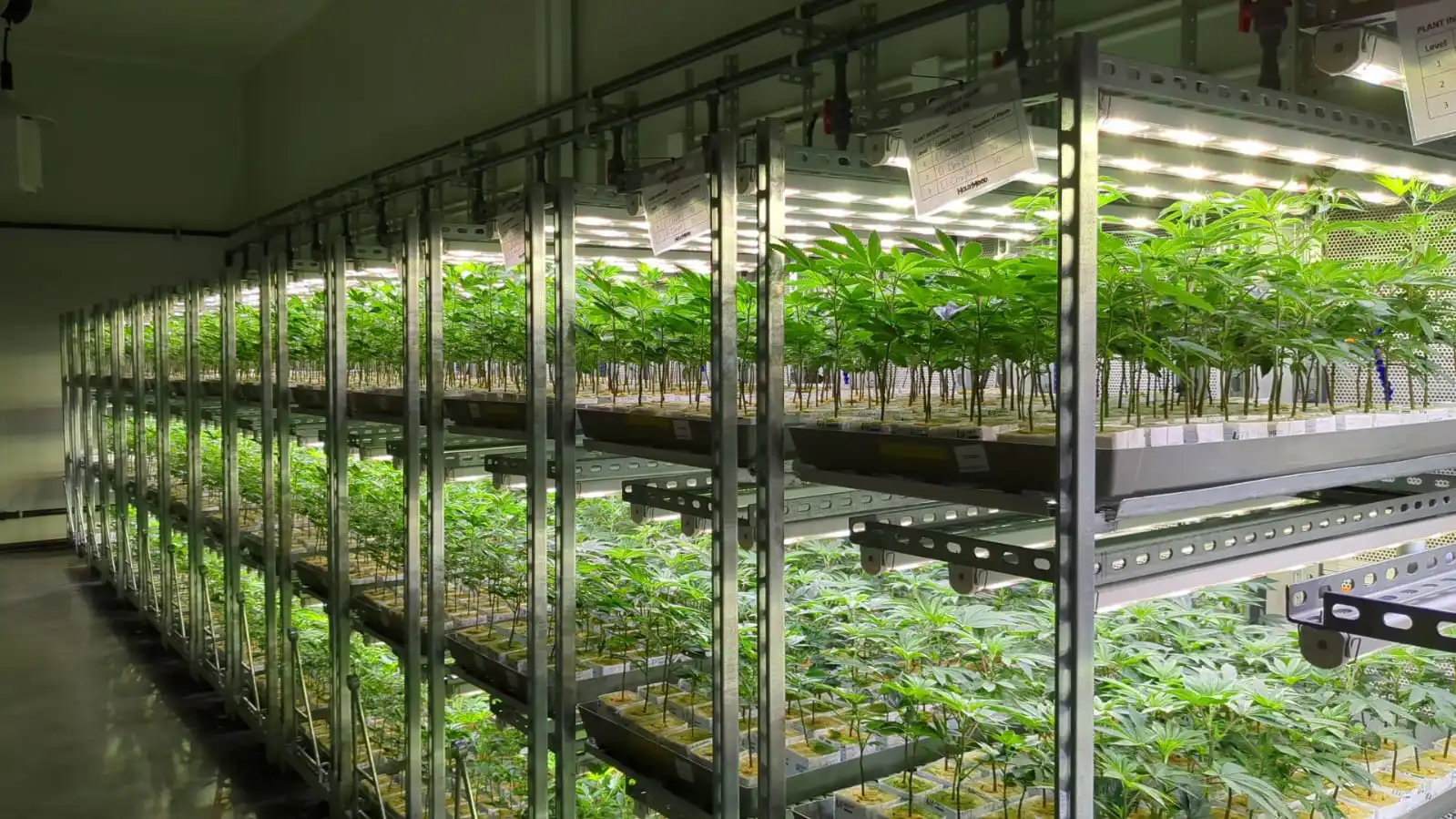
- Advantages: Vertical farming enables year-round cultivation of top-grade cannabis, optimizes canopy space, and lowers cost of goods sold. It significantly increases output compared to single-tier methods and offers a faster return on investment. The approach supports sustainability through water conservation and energy-efficient LED lighting. It also addresses urban space constraints by utilizing stacked shelves or vertical walls, providing uniform lighting and improved environmental control.
- Shipping Container: This segment led the cannabis vertical farming market with a 53.0% revenue share in 2024. (The United States Cannabis Vertical Farming Market Size & Outlook, 2030, 2024) Shipping containers provide precise environmental control, rapid setup, minimal resource requirements, and flexible locations. They offer pest-resistant, controlled environments, reduce crop failure risk, and contain contamination. Containers can be stacked for enhanced production and feature enhanced security with remote monitoring.
- Building-based: This segment is expected to grow rapidly. Although it requires significant initial and operational investment, building-based farming can reduce cultivation costs over larger areas and make the most of space with mobile racking systems, as demonstrated by companies like The Grove.
Hydroponics: Held the largest market share at 47.0% in 2024, valued for cost-effectiveness, simplicity, reduced risk of soil-borne diseases, improved nutrient control, and water efficiency. (Cannabis Vertical Farming Market | Industry Report, 2030, 2023) Hydroponics can reduce water use by up to 80% through nutrient-water recycling. (Sustainable Hydroponics Using Zero-discharge Nutrient Recycling, 2024) According to a report from PR Newswire, the global hydroponic systems market was valued at $9.5 billion in 2020 and is projected to reach $17.9 billion by 2026, highlighting the significant growth and profitability potential of hydroponic cultivation. (MarketsandMarkets™, 2021)
A well-planned facility ensures smooth operations, enables staff to work efficiently, and provides plants with a clear progression, reducing issues and supporting long-term success.
D. Defining Purpose and Scale
Every facility plan should begin with a clear purpose. The choice between indoor, greenhouse, or hybrid setups impacts space and workflow requirements. Production goals, whether small batch or high volume, will guide planning. Consider future growth early to avoid layout limitations. Linking your purpose statement to licensing timelines demonstrates strategic foresight. A defined expansion plan streamlines operations and supports smoother license renewals by aligning your vision with regulatory milestones.
E. Optimizing Layout for Plant & Staff Movement
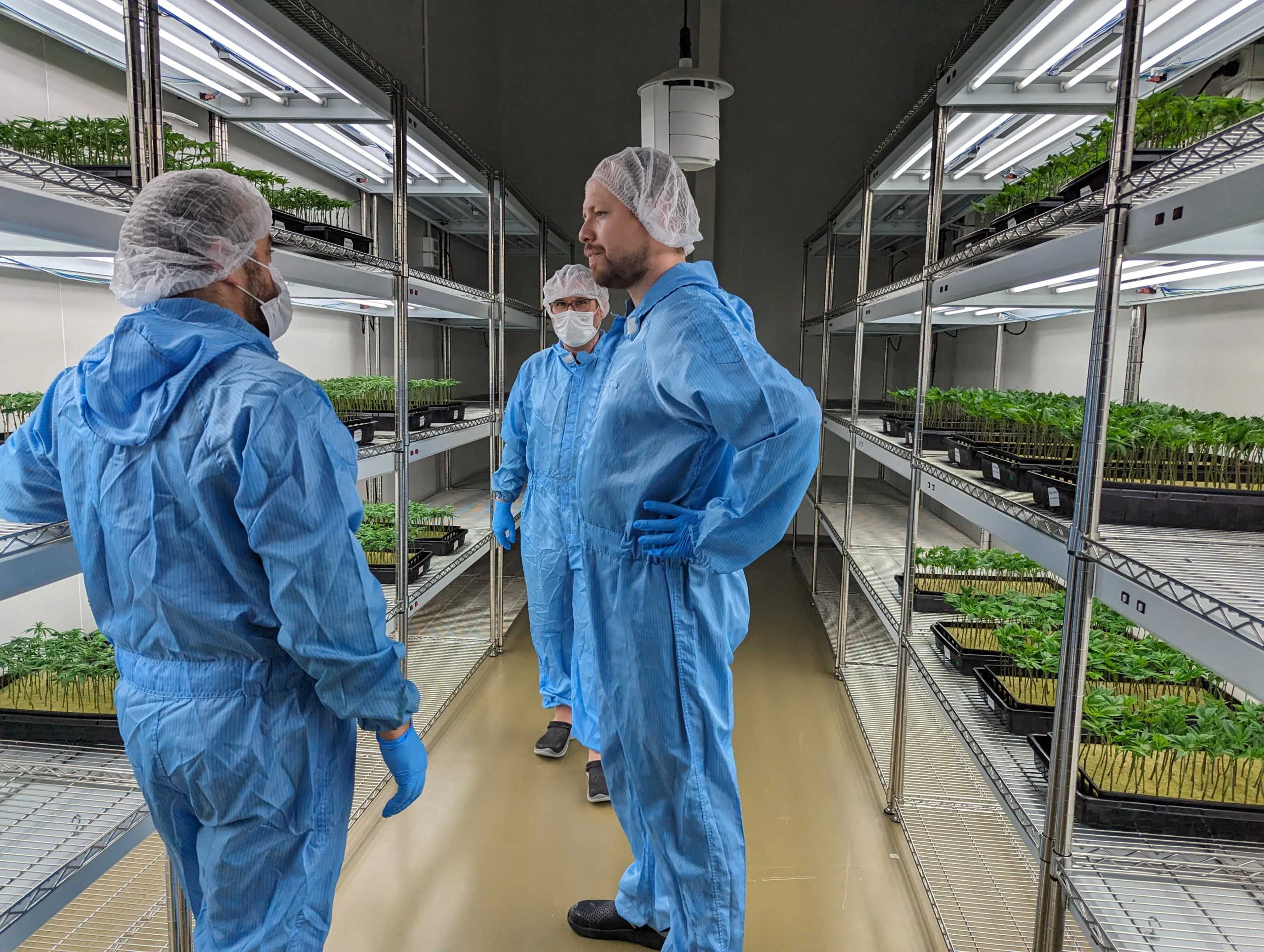
Effective site design aligns with both the plant life cycle and staff routines. Plants should move forward through the facility without backtracking, and staff should avoid crossing sensitive areas. Reducing cross-traffic lowers risks and increases efficiency. Careful layout planning helps prevent bottlenecks and supports smooth operations.
F. Key Functional Areas
A well-designed cannabis with lighting for 18+ hours/day to prevent flowering. Typically occupies 5% of total cultivation space.
- Clone Room: Small plant cuttings develop roots. Maintained at 60-80°F and 50-70% RH, with 18-24 hours of light daily.
- Vegetative (Veg) Room: Plants grow larger for flowering. Requires 70-85°F and 50-65% RH, with 18 hours of light daily. Takes up about 20% of the total cultivation space.
- Flower Room: The final stage before harvest. Kept at 72-85°F and 45-60% RH. from flower rooms.
- Additional Facility Spaces: Including irrigation and water treatment rooms, extraction and lab spaces, packaging and storage areas, and security/compliance zones.
- Support Areas: Beyond cultivation, critical areas include lunchrooms, locker rooms, sanitation spaces, warehouses, vaults, and offices, all essential for a well-thought-out facility.
3. Powering Growth: Critical Infrastructure & Environmental Control
Cannabis cultivation thrivesification. Design is perhaps the most critical system. Proper HVACD keeps steady temperature, humidity, and airflow, preventing microclimates that can lead to mold or disease. Cannabis HVACD systems differ from traditional HVAC systems by being designed for high-humidity loads, 24/7 operation, and CO₂ enrichment. They ensure 100% air recirculation to minimize contamination, use filtration and disinfection to remove airborne pathogens, and prevent the formation of microclimates. HVAC load calculations are essential for supporting stability and determining energy needs for cultivation and post-harvest rooms.
Water and Nutrient Management: Precision Fertigation
Adequate water storage for cleaning and cooling is especially important in hot climates.
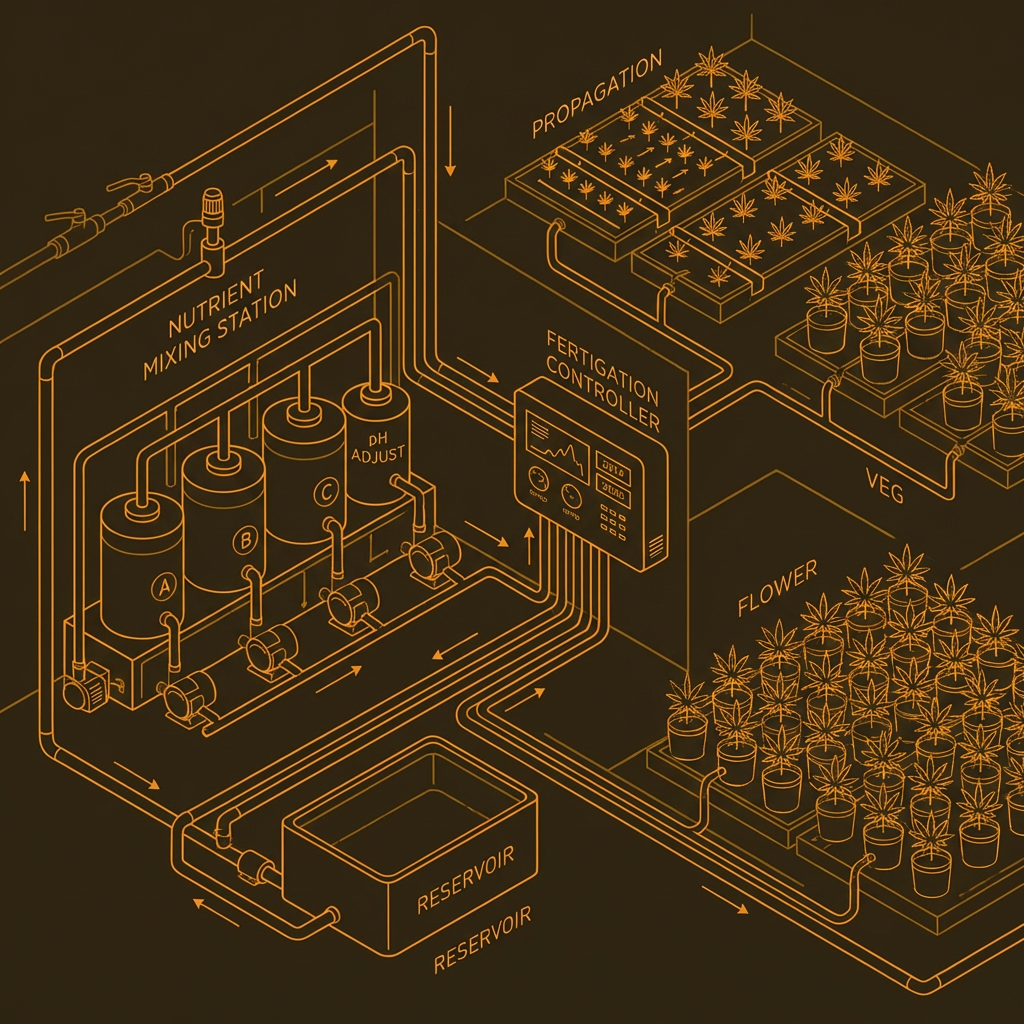
- Fertigation Systems: Efficient fertigation systems deliver accurate nutrient application and irrigation schedules. Reverse osmosis (RO) water is commonly stored and mixed with nutrients before delivery to plants. Automated controls regulate daily watering timetables.
4. Practical Checklist: Cannabis Cultivation Facility Site Design
Cannabis Cultivation Facility Site Design Checklist
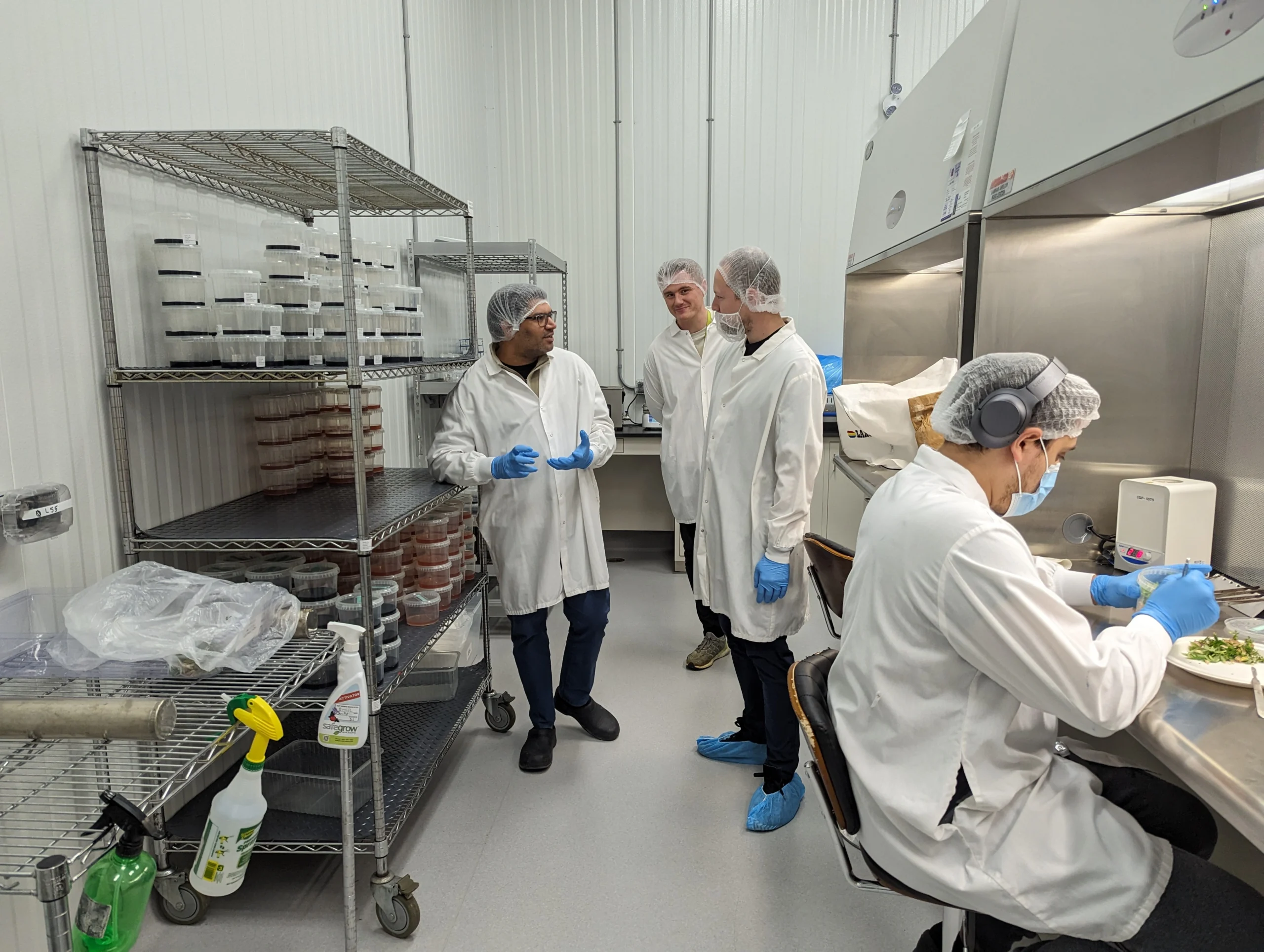
Use this checklist to evaluate site selection, building retrofit readiness, utilities & environmental controls, compliance requirements, and security considerations for a cannabis cultivation facility.
| Category | Item | Description / Consideration | Source(s) | Status (Y/N/N/A) | Notes |
|---|---|---|---|---|---|
| I. Initial Facility Choices & Purpose | |||||
| Define Operating Model | Determine if the facility will be for cultivation, manufacturing, distribution, retail, or a mixed use. | ||||
| Choose Facility Type | Decide between building a new indoor grow facility, establishing a cannabis cultivation greenhouse, or retrofitting an existing warehouse. This choice depends on budget, operation scale, and the local growing environment. | ||||
| Define Purpose & Scale | Clearly understand if the model is indoor, greenhouse, or hybrid, and if the goal is small-batch quality or high volume. Mismatches in scale and intent can lead to problems. | ||||
| Match Site to Needs | Ensure the chosen parcel and jurisdiction can meet the facility's specific space, power, water, mechanical, security, and life-safety requirements. | ||||
| II. Building/Structure Evaluation (for Retrofitting) | |||||
| Structure Condition | Analyze existing proportions, column grids, exits, and plumbing facilities. Determine which elements can be easily modified and which require complete rework. | ||||
| Structural Engineering Inspection | Engage a structural engineer to inspect for deficiencies, asbestos, lead paint, and mold to avoid costly repairs and maintenance. | ||||
| Ceiling Height | Look for facilities with higher ceilings (10-14 feet) to ensure adequate space between equipment (lights, sprinklers) and crops. | ||||
| Drainage System | Ensure proper stormwater drainage away from the building, including storm water inlets throughout outdoor paved areas, to avoid foundation damage. | ||||
| Existing Utility Suitability | Assess if existing utilities (energy, water, sewer, drainage) are suitable for cultivation operations. Adequately sized utilities can save significant costs. | ||||
| Building Code Upgrades | Identify necessary upgrades to meet regulatory requirements, such as exit signs, fire separations, sprinkler installations, and odor mitigation. | ||||
| Future-Proof Planning | Choose a site that allows for additional structures and integrates with the existing layout to support long-term expansion goals. | ||||
| III. Site Selection & General Infrastructure | |||||
| Buffer/Setback Compliance | Eliminate parcels that cannot meet minimum distance requirements from sensitive uses (schools, parks, daycare, rehabs, churches). | ||||
| Site Characteristics | Evaluate utility headroom, truck access, structural capacity, parking, and neighborhood fit. | ||||
| Adequate Power Supply | Ensure the site has access to a sufficient power supply for high electricity loads required by lighting and HVACD. | ||||
| Local Zoning & Compliance | Confirm that the site's local zoning allows cannabis cultivation and other proposed uses. | ||||
| Expansion Potential | Select a site that provides room for future facility scaling without major rework. | ||||
| Mechanical/Electrical Space | Ensure sufficient space for equipment placement and utility connections. | ||||
| IV. Utilities & Environmental Control | |||||
| HVACD System Design | Plan for proper Heating, Ventilation, Air Conditioning, and Dehumidification (HVACD) to maintain stable temperature, humidity, and airflow for healthy plant growth and post-harvest processes. Design for high humidity loads, 24/7 operation, and CO₂ enrichment. | ||||
| HVAC Load Calculations | Perform calculations for cultivation and post-harvest rooms to ensure system capacity for stability. | ||||
| Environmental Setpoints | Determine precise temperature and humidity ranges for each growth stage (e.g., Mother Room: 70-85°F, 40-55% RH). | ||||
| Air Circulation & Contamination | Ensure proper air movement, 100% air recirculation, filtration, and disinfection to prevent microclimates, mold, disease, and airborne contaminants. | ||||
| CO₂ Enrichment Safety | Integrate gas detectors, emergency ventilation, and clear signage for CO₂ enrichment systems to reduce asphyxiation risk, following guidelines like NFPA 420. | ||||
| Electrical Capacity | Plan for adequate electricity for lighting, dehumidification, and cooling. Consider a 3-phase 277/480 panel, a generator with backup power, and a 300kV transformer for a typical 10,000 sq ft facility. Cultivation areas may require 80 watts per square foot. | ||||
| Water Supply & Drainage | Ensure access to allocated water sources for cooling, irrigation, and sanitization storage. Water supply and drainage systems are critical for sanitation and operations. | ||||
| Fertigation System Design | Design an efficient system for accurate nutrient delivery and irrigation schedules. Plan for reverse osmosis (RO) water storage and mixing with nutrients. | ||||
| Water Reclamation System | Implement systems to recycle excess irrigation water (leachate) and recaptured condensation from HVAC systems to improve efficiency and sustainability. Ensure treatment of reused water to prevent pathogen spread. | ||||
| Lighting Selection | Choose horticultural lighting (LED or HID) tailored to goals and budget. Be aware of state mandates for energy-efficient or non-LED options. | ||||
| Wastewater Disposal Plan | Develop a plan for non-reused water disposal, ensuring it goes to a sewer or certified holding tank (not septic systems). Obtain necessary permits for discharge to ground/surface waters. | ||||
| Water Impact Plan (if applicable) | For example, in Nye County, Nevada, a water impact plan showing proposed water use and wastewater disposal is required before an initial license is issued. | ||||
| V. Regulatory & Compliance | |||||
| State & Local Regulations | Understand and comply with all applicable state laws, local jurisdiction planning, and building codes. | ||||
| Zoning Codes Review | Carefully review use tables, maps, conditional use permits (CUPs), setbacks/buffer zones (schools, parks, churches), business density caps, "green zones," and potential moratoriums. Verify how AHJ (Authority Having Jurisdiction) measures buffers. | ||||
| Special Use Permit | Obtain any required special use permits, noting they are often specific to the business owner and can be revoked for non-compliance. | ||||
| Change of Use Review | If retrofitting, confirm if the project constitutes a "change in use" requiring rezoning or conditional approvals. | [12, covering construction materials, electrical demands, ventilation, and storage of flammables. | |||
| Hazardous Location Classification | Identify if any extraction spaces trigger C1D1 or C1D2 classifications, requiring early coordination with fire officials and engineers. | ||||
| Odor Mitigation Plan | Implement ventilation and air quality control systems, such as carbon filters, air scrubbers, and negative pressure rooms, to manage odor emissions and comply with local requirements. | ||||
| Waste Management Plan | Develop procedures for rendering cannabis waste unusable (e.g., mixing with 50% other materials and grinding) before disposal or composting, per state regulations. Plan for special disposal of hazardous waste like pesticides and mercury-containing bulbs. | ||||
| Water Quality Permits (if applicable) | Determine if water quality permits are needed for wastewater discharge (e.g., containing excess potential impacts from wastewater, solid waste disposal, CO2 use, and odors. | ||||
| GACP/EU GMP Compliance | If aiming for specific markets (e.g., medical, export), ensure the facility design supports Good Agricultural and Collection Practices (GACP) and Good Manufacturing Practices (GMP) standards. | ||||
| VI. Security | |||||
| Controlled Access | Design the layout to support controlled access and oversight, ensuring predictable movement paths and clear surveillance sightlines. | ||||
| Surveillance System | Install cameras covering entrances, interior, and exterior, with recordings maintained for at least 61 days. | ||||
| Restricted Activities | Prohibit outdoor cultivation, processing, display, sales, or storage. Ensure marijuana/paraphernalia is not visible from outside the facility. Prohibit anyone under 18 years and any consumption on the premises. | ||||
| Security Plan Submission | Submit a detailed security and transportation plan outlining proposed security for the site, buildings, vehicles, cameras, fencing physical space. | ||||
| Growth Considerations | Plan for future growth from the beginning, ensuring the initial layout does not restrict future options and allows for scalability. | ||||
| Modular Spaces / Phased Build-outs | Design with flexibility in mind, using modular spaces or planning for phased build-outs to add capacity without extensive rework, preserving capital and momentum. | ||||
| Cost & Timeline Expectations | Account for significant project costs driven by build-out scope, operational systems, and compliance. Build in buffer time for permitting, inspections, and approvals, as these often take longer than expected. | ||||
| VIII. Common Pitfalls to Avoid | |||||
| Underestimating Space Needs | Avoid focusing solely on cultivation rooms; plan comprehensively for support functions like lunchrooms, locker rooms, sanitation, warehouses, vaults, and offices. | ||||
| Ignoring Future Growth | Do not design a facility that will quickly be outgrown; plan for expansion from the start. | [5 | |||
| Signing Leases Too Early | Do not commence rent before confirming zoning, buffer compliance, and utility upgrade paths. Use Letters of Intent (LOIs) with appropriate contingencies. | ||||
| Under-Scoping Power | Develop a detailed, bottom-up load schedule for all equipment instead of relying on rule-of-thumb estimates. | ||||
| Ignoring Odor & Ventilation | Address robust compared to light industrial operations. | ||||
| Skipping Specialty Advisors | Engage cannabis-literate architects, MEP engineers, code consultants, and general contractors to avoid costly redesigns and delays. |
If you want expert eyes on this checklist, CannaCribs Consulting and the GrowersHouse commercial division both support full-cycle planning—from cultivation system design and cultivation facility layout to equipment sourcing and cultivation SOPs.
Q&A Section
What are the primary types of cannabis cultivation facilities, and what factors affect the choice between them?
Cannabis cultivation facilities typically fall into three main categories: building a new indoor grow facility, establishing a cannabis cultivation greenhouse, or retrofitting an existing warehouse.
There is no one-size-fits-all facility when it comes to cannabis cultivation; the ideal choice depends on numerous factors:
- Budget.
- Functional scale.
- Local growing environment.
Retrofitted warehouses can be profitable when executed with the right expertise, offering benefits such as an extended growing season and maximized environmental control. However, before even considering retrofitting, it's crucial to address zoning as the first due diligence gate. Ensuring compliance with municipal setbacks and zoning laws early on can save legal headaches down the line.
Only after confirming that the property meets zoning requirements should operators proceed to evaluate the existing structure, including aspects like column grids, exits, and plumbing. Additionally, assessing utility services (electricity, water, sewer, drainage), ensuring compliance with building codes, and securing proper engineering permits remain essential steps in this approach.
Cannabis greenhouses have become popular because of their sustainability, functionality, and versatility, combining the benefits of both outdoor and indoor cultivation. Specific styles, such as the Hybrid Vail and Venlo, offer different features and benefits customized for various climates and working needs.
Vertical farming is an innovative method that increases space efficiency by growing crops on stacked shelves or vertical walls within shipping containers or purpose-built facilities, offering high yields and output.
Why is a comprehensive facility blueprint as well as strategic planning necessary for a cannabis cultivation business?
A detailed facility blueprint is an important planning tool. It shows how your operation will work once people, plants, and regulators are in the building.
This early planning is key for several reasons:
- A well-planned facility helps staff work efficiently, gives plants a clear path through each stage, and makes daily tasks easier. Strategic planning addresses scalability and future growth from the outset, enabling expansion without extensive rework and protecting both the budget and momentum.
- Working with consultants who know the cannabis industry helps turn regulations into practical layouts and workflows, reducing uncertainty and supporting long-term stability.
What critical infrastructure plus environmental control systems are essential for a high-performing cannabis cultivation facility?
Strong infrastructure and effective environmental controls are key to maintaining plant health, achieving high yields, and meeting regulatory requirements in a top-performing cannabis facility.
Key systems include:
- HVACD (Heating, Ventilation, Air Conditioning, and Dehumidification): This system is important for maintaining stable temperature, humidity, and airflow, preventing microclimates that can lead to mold or disease. Cannabis HVACD systems are specifically designed for high-humidity loads, 24/7 operation, and CO₂ enrichment. They often support 100% air recirculation to minimize contamination and incorporate filtration and disinfection for airborne contaminants.
-
Water and Nutrient Management:
- Efficient fertigation systems provide exact nutrient levels.
- Water reclamation systems recycle excess irrigation water (leachate) and condensation from HVAC systems, improving efficiency and ecological sustainability. Recaptured water requires treatment to prevent pathogen spread and to reduce levels of ionic/toxic elements.
- Lighting and Energy Requirements: Cultivation areas need considerable electrical capacity—often planned at around 80 watts per square foot in many designs—along with utility planning (e.g., adequate service size, potential backup generators, and realistic transformer lead times). Energy-efficient LED lighting solutions can help reduce consumption and support compliance requirements.
- CO₂ Enrichment: These systems can improve photosynthesis, leading to faster plant growth and higher yields. They require integrated gas detectors, emergency ventilation, and visible signage to mitigate asphyxiation risks, as outlined in developing standards like NFPA 420.
What are the key functional areas within a cannabis cultivation facility, and what specific conditions do they require?
A well-designed cannabis cultivation facility organizes its space into dedicated cultivation rooms and support / processing areas, each with specific environmental setpoints and operational requirements.
- Mother Room: Houses mature plants used for propagation. Requires temperatures between 70–85°F, 40–55% relative humidity (RH), and 18+ hours of lighting daily to prevent flowering. This area typically occupies about 5% of the total cultivation space.
- Clone Room: Where small plant cuttings develop roots before transplanting. Maintained at 60–80°F and 50–70% RH, with lighting for 18–24 hours daily to encourage root growth.
- Vegetative (Veg) Room: Plants grow larger in preparation for flowering. Typical conditions include 70–85°F and 50–65% RH, with lighting remaining on for 18 hours daily.
- Flower Room: Plants mature to produce buds. Conditions are commonly maintained around 70–80°F and 45–60% RH. Lighting cycles shift to 12 hours on / 12 hours off to trigger flowering. This is typically the largest cultivation area, representing about 70% of the total space.
-
Support and Processing Areas: These are important for overall operation and include:
- Irrigation and water treatment rooms.
- Trimming, drying, and curing rooms, designed to match the batch sizes from flower rooms.
- Packaging and storage areas.
- Security and compliance zones, with restricted-access areas.
How do regulatory requirements, zoning, and building codes impact the site design?
Regulatory requirements, zoning, and building codes profoundly impact every stage of designing and operating a cannabis facility, frequently dictating where, how, and what can be built. Ignoring these constraints can cause substantial delays, financial penalties, or even project termination.
To help operators stay ahead of evolving requirements, consider building a regulations tracker—a living spreadsheet that tracks changes to fire codes, wastewater rules, and security mandates. This reinforces a proactive habit of monitoring compliance.
-
Zoning and permits: Zoning laws determine where a cannabis facility can operate. This typically involves reviewing:
- Setbacks and buffer zones from sensitive locations like schools, parks, or churches.
- Business density caps and any required Special Use Permits. These are often specific to the business owner, so transferability can be a key consideration.
-
Building codes and standards: Facilities must meet local building code requirements, including (as applicable) exit signs,
fire separations, and sprinkler installations.
- NFPA 420: Standard on Fire Protection for Cannabis Growing and Processing Facilities is being developed to address cannabis-specific fire risks.
- These standards can affect construction materials, electrical demands (grow lights and ventilation), ventilation systems, storage of flammable materials (fertilizers, pesticides, extraction solvents), CO2 enrichment safety (gas detectors, emergency ventilation), and safe waste removal.
- Security and compliance: Regulations often mandate robust security measures, including access control systems and comprehensive surveillance (interior and exterior, with recordings maintained for at least 60 days), site lighting, and burglary alarm systems.
-
Wastewater, odor, and waste handling:
- Wastewater disposal typically requires permits and cannot be discharged to septic systems; industrial holding tanks or approved facilities may be required.
- Odor control requirements may drive HVAC and filtration choices, and affect room pressurization and exhaust planning.
- Cannabis waste is often required to be rendered unusable (for example, mixed with 50% other materials and ground) prior to disposal or composting, consistent with solid waste handling standards.
- Hazardous waste (such as certain pesticides or oils) is typically subject to additional storage, handling, and disposal rules.
- Hazardous location classification: Certain processes (such as extraction) can trigger hazardous area classifications that affect electrical design, ventilation, and fire protection, requiring early coordination with fire officials and engineers.
What are the different types of Greenhouses?
Cannabis greenhouses come in multiple designs, each optimized for different climates, operational goals, and environmental control needs. Two common types include the Hybrid Vail and the Venlo greenhouse.
-
Hybrid Vail Greenhouse
- Features: Uses a traditional peak-style design with a 6/12 roof pitch for interior condensation control and maximum snow shed.
- Benefits: Cost-efficient due to factory-welded galvanized steel trusses that simplify and reduce construction time and cost. Wide-span trusses minimize shadowing, increase usable crop space, and support production automation. Diffused polycarbonate roof coverings can improve light deprivation during flowering and help balance natural sunlight with supplemental lighting for vegetative growth. Integrated dehumidification systems may be available for nighttime use, humidification, and cooling.
-
Venlo Greenhouse
- Features: A Dutch-style structure known for high light transmission and energy retention. It typically uses separate, guttered high ceilings to increase air circulation and help prevent heat from trapping on plants. Often designed as an airtight structure optimized for maintaining elevated CO2 levels.
- Benefits: Strong environmental control throughout the growing zone. Exterior sidewalls can improve security and reduce unwanted light intrusion. Higher gutter heights can help buffer humidity and temperature swings.
- Best use: Well-suited for large commercial operations, especially in regions with harsh winter climates.
What is vertical farming in cannabis cultivation, and what advantages does it have?
Vertical farming in cannabis cultivation is a production method that increases space efficiency by growing plants on stacked shelves or vertical structures (often inside shipping containers or purpose-built indoor facilities). It is used to optimize production and address constraints related to space, energy efficiency, and budget in a competitive, highly regulated industry—often enabling higher output versus traditional single-tier cultivation.
- Continuous, year-round production: Enables consistent cultivation of cannabis throughout the year, independent of outdoor conditions—supporting consistent quality and potency.
-
Resource efficiency:
- Water conservation: Many vertical systems use hydroponics and/or recirculating irrigation approaches to reduce water use.
- Energy optimization: Often pairs well with power-saving LED lighting that can deliver customizable light spectra, longer operating lifespans, and improved heat management.
- Pest and contamination control: A controlled (often sealed) environment can reduce the risk of pests, disease, mold, and other contamination—supporting more reliable operations.
- Flexibility and expandability: Shipping-container farms can offer turnkey setups, quick deployment, portability, and minimal on-site resource requirements. Building-based vertical farms can also be designed to scale by adding racks/zones as capacity grows.
Vertical farming is frequently paired with hydroponics in cannabis facility design due to perceived benefits like simplicity, nutrient control, reduced soil-borne disease risk, and improved water efficiency. Some market reports (e.g., GlobeNewswire coverage) project continued growth in the global hydroponics market.
What are common pitfalls in cannabis facility design and planning, and how can they be avoided?
Designing and planning a cannabis cultivation facility involves many interdependent systems (MEP, workflow, compliance, security, utilities), and several common pitfalls can cause delays, cost overruns, or operational problems. Recognizing them early helps protect schedule and budget.
-
Underestimating support-space needs: Focusing only on canopy and cultivation rooms while underplanning support areas (staff,
sanitation, storage, waste, compliance circulation).
Avoidance: Plan support areas comprehensively from the outset, based on workflow and staff needs—not only plant canopy. -
Ignoring future growth and scalability: Building a layout that can’t expand without major rework.
Avoidance: Design modular rooms and phased build-outs so capacity can be added without redesigning the entire facility. -
Treating compliance as an afterthought: Failing to integrate code, life-safety, security, odor, and waste requirements early.
Avoidance: Incorporate compliance requirements in concept design and engage cannabis-experienced compliance advisors early. -
Underestimating power and utility requirements: Indoor cultivation can be highly energy-intensive; utility upgrades and
transformer lead times can impact schedule.
Avoidance: Build a detailed bottom-up load schedule for all equipment, confirm service capacity and upgrade paths with providers, and engage experienced civil and electrical engineers early. -
Signing leases too early: Committing to rent before confirming zoning, permitting, setback/buffer compliance, and utility
upgrade feasibility.
Avoidance: Use Letters of Intent (LOIs) with contingencies tied to permitting, utility energization, and due diligence. -
Ignoring odor and ventilation: Odor abatement and pressure zoning are often strict requirements and must be engineered.
Avoidance: Integrate odor control (e.g., carbon filtration, air scrubbers, pressure zoning) into the HVACD design from the beginning. -
Treating cannabis facilities like standard light industrial: Underplanning for high humidity loads, 24/7 HVACD operation,
CO2 enrichment, hazardous classifications (e.g., C1D1/C1D2 in extraction), and security requirements.
Avoidance: Use cannabis-specific design criteria and coordinate early with MEP, code, fire, and security stakeholders. -
Skipping specialty advisors: Using teams unfamiliar with cannabis-specific constraints can lead to redesigns and delays.
Avoidance: Work with cannabis-literate architects, MEP engineers, code consultants, and contractors who can translate regulatory requirements into practical layouts and identify risks early.
References
- (n.d.). Colorado Air Compliance Tracking and Inventory System. https://spl.cde.state.co.us/artemis/heserials/he171013internet/he1710132024q3internet.pdf
- (April 23, 2023). 2023 State of the Cannabis Cultivation Industry Research. Cannabis Business Times. https://www.cannabisbusinesstimes.com/business-issues-benchmarks/state-of-the-cannabis-cultivation-industry/article/15687669/2023-state-of-the-cannabis-cultivation-industry-research
- (2025). 18 Tips to Help You Convert a Building into a Cannabis Cultivation Facility. Cannabis Business Times. https://www.cannabisbusinesstimes.com/home/article/15702264/18-tips-to-help-you-convert-a-building-into-a-cannabis-cultivation-facility
- (2025). Electricity Usage Reporting Requirements. California Department of Cannabis Control. https://www.cannabis.ca.gov/posts/electricity-usage-reporting-requirements/
- (2025). Lower Cannabis Cultivation Energy Costs in Rockford. Illinois Commercial Energy. https://illinoiscommercialenergy.com/resources/lower-cannabis-cultivation-energy-costs-rockford/
- (2024). The United States Cannabis Vertical Farming Market Size & Outlook, 2030. Grand View Research. https://www.grandviewresearch.com/horizon/outlook/cannabis-vertical-farming-market/united-states
- (2023). Cannabis Vertical Farming Market | Industry Report, 2030. Grand View Research. https://www.grandviewresearch.com/industry-analysis/cannabis-vertical-farming-market-report
-
(2024). Sustainable Hydroponics Using Zero-discharge Nutrient Recycling. Joint Action for Water (JAW).
Sustainable Hydroponics Using Zero-discharge Nutrient …
- MarketsandMarkets™. (January 24, 2021). Hydroponics Market worth $17.9 billion by 2026 - Exclusive Report by MarketsandMarkets™. PR Newswire. https://www.prnewswire.com/news-releases/hydroponics-market-worth-17-9-billion-by-2026--exclusive-report-by-marketsandmarkets-301213867.html
- (November 25, 2025). Hydroponics Market Competitive Landscape Report 2025: Company Analysis, Recent Developments, Strategy, Sustainability, Product Launch, Key Persons and Revenue. GlobeNewswire. https://www.globenewswire.com/news-release/2025/11/26/3194919/28124/en/Hydroponics-Market-Competitive-Landscape-Report-2025-Company-Analysis-Recent-Developments-Strategy-Sustainability-Product-Launch-Key-Persons-and-Revenue.html