Under Canopy Lighting: Boost Yield, Bud Quality & ROI in Commercial Cannabis
[Video Breakdown]
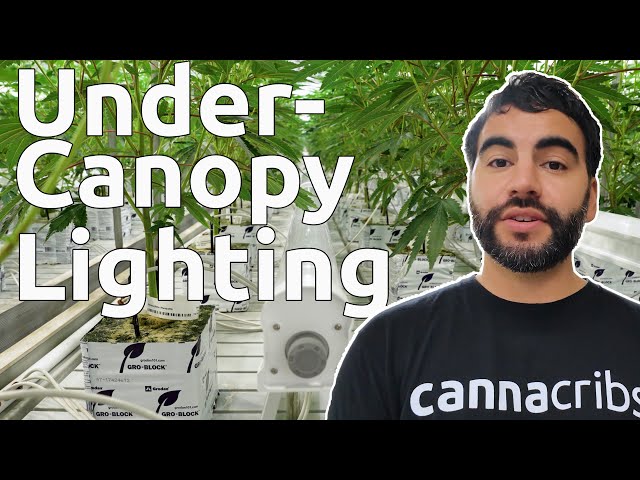
Under-canopy LED bars (placed below the plant canopy) can help turn lower “popcorn” buds into denser, higher-value flower—without expanding your footprint. In this CannaCribs episode, Nate breaks down the real-world benefits, the data behind the hype, and how to vet fixtures using third-party testing (DLC).
Key Takeaways
- Under-canopy lighting is increasingly treated as a competitive necessity for commercial growers trying to increase grams per sq ft.
- The biggest upside is converting lower/middle sites into more “A-grade” flower instead of larf/popcorn.
- Benefits go beyond yield: reduced lollipopping labor, better plant structure, and potentially improved microclimate below the canopy.
- Reported results cited include yield and quality gains in multiple trials/case studies (e.g., ~20%+ yield lifts in some setups).
- Don’t shop on marketing claims alone—use third-party listings and tested photometric performance where possible.
- Timing, HVAC capacity, airflow, and correct placement determine whether under-canopy is a win or a headache.
BUILD GUIDE MENU
Why under-canopy lighting is “the hot topic” right now (0:10–1:30)
Commercial cultivation economics reward higher output from the same footprint. Under-canopy aims to “unlock yield that’s already there” by pushing usable light into shaded bud sites.
The 6 core benefits (1:32–3:49)
- More yield, same footprint (more harvestable biomass from lower sites)
- Better bud quality (fewer “popcorn” buds, more dense nugs)
- Full-plant photosynthesis (more uniform growth, less stretch)
- Labor savings (less lollipopping/pruning)
- Airflow & microclimate friendly (slim bars; measure temps/RH before/after)
- Potential pest/disease pressure reduction (fewer dark, humid hiding zones)
What the data says (3:51–4:52)
The video references multiple studies/tests reporting meaningful improvements in yield and flower quality when under-canopy lighting is used, including case-study style performance results (Under Canopy Lighting – LED Grow Lights Reviews & Testimonials)
Choosing the right fixture: specs that matter (4:54–6:08)
Nate highlights three big spec buckets:
- Wattage
- Spectrum
- Efficiency (µmol/J) — a “miles-per-gallon” style metric for how effectively a light converts electricity into usable photons.
How to spot marketing hype: use the DLC Hort QPL (6:08–10:08)
The DesignLights Consortium (DLC) maintains Qualified Products Lists (QPLs), including a horticultural category, and notes that product info/search functionality is unlocked via a MyDLC account.
What to look for on listings:
- Reported vs tested photometric performance (catch “inflated” marketing numbers)
- Spectrum breakdown (blue/green-red/far-red bands)
- Evidence of third-party vetting (useful for reliability and potential utility programs)
Work With Experts on Your Cannabis Financial Model
The CannaCribs horticulture consulting team builds cannabis cultivation financial modeling regularly, drawing on real data from facilities they’ve operated, designed, and optimized around the world. They can help you validate your assumptions, refine your layout, and produce a professional financial deck that speaks the language of investors—covering facility layout, CapEx, OpEx, yields, and key KPIs.
Things to avoid when implementing under-canopy (10:09–12:23)
The video flags common pitfalls:
- Running them too early in the cycle (wasted energy)
- Underestimating heat/HVAC + humidity load
- Bad placement (wrong height/angle)
- Spectrum mismatch concerns (avoid confusing plant photoreceptors)
Full Transcript
[00:00:00]
[Music]
[00:00:03]
[Applause]
[00:00:10]
Hey everyone, Nate from CannaCribs. So today we’re talking about under canopy lighting because it is one of the hottest topics in cannabis cultivation at this moment in time. And if you’re not using under canopy lighting in your cannabis grow and you’re growing as a business, you’re probably kind of falling behind. So, let’s chat about that a little bit.
[00:00:31]
You know, if you’re not using under canopy lighting, you could be losing yield to larger buds and your competition could be pulling more weight and more A-grade colas. You know, referring to those larger, more dense, potent buds that normally are only at the top of your plant, but you can be getting those in the middle and bottom of your plant. So, they’re doing that with the same amount of square footage.
[00:00:52]
Under canopy really isn’t the latest trend. It’s becoming a necessity for a lot of growers who want to stay competitive and boost their yields per square foot and maximize the value of every plant they have in their facility.
[00:01:05]
When building out new facilities or optimizing existing facilities, our CannaCribs consulting team is now recommending under canopy for all building installations. As long as you have the budget for it, it makes a ton of sense on the front end.
[00:01:18]
So, let’s go over why under canopy lighting is changing the game and teach you some tips and tricks of how to shop for under canopy lighting, so that you know the difference between marketing hype and true performance of a light.
[00:01:32]
Benefits
Let’s talk about the core benefits of under canopy lighting first. There are six of them. When we talk about under canopy lighting, we’re really talking about unlocking yield that’s already there in your plant. It’s just kind of hiding in the shadows. Let’s go over a few points that are really important to note.
[00:01:48]
One: you can get more yield from your garden with the same footprint. So, by illuminating the lower bud sites that are otherwise remaining shaded, the under canopy lighting unlocks basically this additional harvestable biomass. It supports higher grams per square foot without expanding the facility footprint—especially impactful for environments where expanding your footprint can be very costly.
[00:02:12]
Two: boost in bud quality. A lot of your plant—what comes off of it—are these popcorn-like buds. With light reaching the lower branches, you’re going to get more dense A-grade nugs, as I mentioned earlier.
[00:02:25]
Three: full plant photosynthesis. Cannabis plants tend to stretch towards the light source, which can lead to elongated stems and less desirable bud structure. But providing light from below makes the plant grow a little bit more uniformly, and it reduces the need for the stretch—resulting in a sturdier, more desirable plant morphology.
[00:02:43]
Four: labor saving. Cannabis growers usually trim or prune plants below the canopy. This “lollipopping,” as it’s commonly known, makes sense when you don’t really have good bud formation down there on that bottom part of the plant—but it does take a lot of time. So, with under canopy lighting, you can eliminate or vastly reduce the amount of time it takes for you to lollipop your plants because you’re going to get good bud formation down there.
[00:03:10]
Five: air flow and microclimate friendly. Under canopy lights are slim and passively cooled bars, and they won’t really block air flow or create heat pockets as long as you have proper air flow in your room. Make sure to measure the air flow, the temperature, and the humidity within your canopy before and after installing your lights to see if fans need to be adjusted or added.
[00:03:32]
Number six: decreasing pests and disease. This one’s kind of crazy, but under canopy lighting actually deters some pests from hanging out in the shadowy areas of your plant. So, the under canopy lighting also reduces the relative humidity in that area below the plant, which makes the area less hospitable to some pathogens and pests.
[00:03:51]
Data
Let’s next talk about some data that supports some of these results. For example, a study highlighted by TSR Grow revealed a 20% increase in yield and a 27% enhancement in bud size when under canopy was utilized.
[00:04:04]
Practical applications further support these findings. For instance, a performance test of California Lightworks Mega Drive under canopy system reported a 29.84% increase in total dried trimmed flower and 11% rise in A-grade flowers at the Harborside greenhouse. Yes, a greenhouse—not an indoor facility.
[00:04:24]
Similarly, this research conducted by Thrive Agritech indicated that integrating under canopy lighting led to a substantial increase in A-grade flowers—referring to the highest quality buds versus buds which are lower quality, less dense, and less potent. Not only were there more buds, but they also exhibited an increase in cannabinoid and terpene profiles throughout the plant, accompanied by a notable 5% increase in THC levels across the crop.
[00:04:49]
Now, we’re going to link all these studies below so that you can click through and see them for yourself.
[00:04:54]
Choosing the Right Fixture
Now, let’s talk about choosing the right fixture. Let’s start by talking about how under canopy lights are measured. Usually it will be by wattage, spectrum, and efficiency of the lights—measured by a term called micromoles per joule (µmol/J). You will see it often notated, and it basically measures how efficient a grow light turns electricity into usable light for your plants.
[00:05:18]
The more micromoles per joule you have, the more light you’re getting to your plant per watt of energy that you’re paying for—basically, more yield per watt that goes into your plants.
[00:05:27]
For example, if a light is rated at 2 µmol/J and another one is rated at 3 µmol/J, then the light at 3 µmol/J is 50% more efficient at converting power wattage into plant-growing light. It’s kind of like miles per gallon in your car, but for grow lights and photosynthesis.
[00:05:50]
Some companies will claim a certain amount of micromoles per joule—whether it’s on their packaging, their advertising—but sometimes they might budge a little bit on that marketing rating to entice customers, to make them think that their light is actually maybe a little bit more efficient than it actually is. We’re going to teach you how to be an informed buyer. Let’s jump into that.
[00:06:08]
First, there’s a third-party organization called DLC, which stands for DesignLights Consortium. DLC is an independent organization that provides third-party testing and certification for LED grow lights, ensuring that they meet strict energy and performance standards. Their certification helps growers identify high-quality, reliable lighting products that may qualify for utility rebates.
[00:06:33]
Let’s jump over to the website really fast and I’ll show you how to use it. Okay, so here’s the DesignLights Consortium website. First thing you need to do is you need to make an account. You can’t access the proper reporting without making an account.
[00:06:46]
Then once you do that, click on “Find Products” and then go to “Hort QPL.”
[00:06:51]
Once you click into Hort QPL, you can basically search any LED grow light that has ever been submitted to the DLC. And basically, if a light is from a well-known manufacturer and it’s a light that you can get rebates from—like, let’s say, your local energy company—it probably is in the DLC.
[00:07:13]
And I would even venture to say that I would be very reticent to buy a light that’s not listed in the DLC because that doesn’t mean that you probably have third-party reporting showing how efficient or non-efficient that light is.
[00:07:27]
So, if you first get into the DLC, how you search lights is just searching any light. So I can look up, for example, Grower’s Choice LED lights—another popular brand. We sell a lot of them. You can see the under canopy light and a few of their other lights.
[00:07:44]
After you do that, you can start searching for fixtures. Like, for example, we’re talking about under canopy lights today. I jumped over and looked—this is one of the most popular under canopy lights out there. This is the Craft Farmer light, and he was really someone who popularized under canopy lighting.
[00:08:01]
And here’s how you go through the website. First is reported photometric performance. Then tested photometric performance. Reported photometric performance is what the company said their performance of the light is.
[00:08:14]
So here is the micromoles per joule: 2.4. And then it has total reported photosynthetic photon flux—basically 288 µmol.
[00:08:25]
And then if you look at this part down here, it’ll actually show you the spectrum: 400 to 500 nanometers, 500 to 600, 600 to 700. So this is more blue light—400 to 500—and 500 to 600 is more white light. And then 600 to 700 is really more red light, and then 700 to 800 is really more far red.
[00:08:44]
So I can see that this is a red-dominant light—not so much a far red, but a red-dominant one.
[00:08:48]
Now what I can also do here is go to tested photometric performance, which actually shows when the light was tested by a third party, what reports they got.
[00:09:01]
So the reported was 2.4, but the tested is 2.5. That’s actually really good. That means they report less than they actually tested at.
[00:09:08]
What you really want to look for is when someone reports something like—let’s say they reported like a 2.7 and it actually tested in a 2.5. That means they are actually saying that the light is more efficient than it actually is.
[00:09:19]
And you can see the spectrum here follows a very similar ratio as it does up here. So I would say that’s very honest in terms of its output.
[00:09:29]
And you can see there’s other lights in here. You can see—here’s a California Lightworks under canopy light. This is a new one that came out with some new updated technology. It’s at 3.22 micromoles.
[00:09:42]
And if you go down here to the tested photometric performance, you can see that they’re tested as 3.204. So it’s really spot-on. And you can look at the spectrum on this one—not really far reds here, but a deep, deep amount of reds in terms of the output.
[00:10:00]
So that’s how you can really use this website to drill in and understand what the third-party testing is of these specific lights.
[00:10:09]
Things to Avoid
Now that we know how to use the DLC website, let’s actually go over a couple other things because, like everything in life, under canopy lighting is not perfect. There are certainly things to watch out for when using under canopy lighting.
[00:10:21]
Number one: turning on the lights too early in your schedule. Don’t use under canopy lighting during all phases of your plant’s growth cycle. Like, for example, do not use them in veg. It’s wasted energy. You actually also do not need to use them in early flower. The ideal time to turn them on is usually about 14 to 21 days into flower, after your plants have gotten through their initial stretch.
[00:10:46]
Two: heat buildup under the canopy. When you add more power into your grow rooms, you will also add more heat. Ensure that you have enough HVAC to withstand the added heat load.
[00:10:55]
Like when the canopy is full, the crop will likely have higher overall transpiration rates with the addition of under canopy lights. So this might also increase the humidity load—so make sure you have adequate dehumidification.
[00:11:06]
And also make sure that you have good air flow throughout your rooms. If you have stagnant air under the canopy, you could see some heat stress on your plants. So make sure that you get some air flow down there and monitor your temps at the canopy bottom.
[00:11:24]
Three: placement of them. Poor placement can cost you. Really make sure you place your under canopy lights in the proper spot where they should be pointing up at your plants, and usually about 8 to 12 inches below the canopy where those leaves are.
[00:11:39]
And normally you’ll see them on stands. Stands are highly recommended, and then you can adjust them to the right height.
[00:11:47]
Number four: matching the spectrum to your plants. While we don’t have a ton of data on this, it’s kind of recommended that you try to match the spectrum of your top lights so you don’t confuse your plant’s photoreceptors.
[00:11:59]
Light spectrum guides plant development. And conflicting signals, some people think, can stress out a plant or reduce the efficiency of your lighting.
[00:12:07]
If your top lights are full spectrum, we kind of recommend getting a full spectrum under canopy light—or at least one where that’s not a super deep red and only reds. If your top lights have red-enhanced diodes though, then maybe you can use something that does have a deeper amount of reds for your under canopy lighting.
[00:12:25]
Products
Lastly, let’s run through some products because there is no one-size-fits-all with under canopy lighting. Let’s break them down in terms of power, spectrum, unique features, and which light might be best suited for you.
[00:12:38]
We did build a blog post that is linked below on our site, and it has a chart that shows every under canopy that we sell—and we sell the majority of them.
[00:12:45]
Each light does have their own specifications that make them either more powerful, more efficient, or better suited for certain facilities. As I said earlier, there’s no one light that’s best for everyone, but there is probably one that’s best for your operation and your budget.
[00:13:00]
Illuminar has the most powerful 4-foot under canopy bar that we know of at 160 watts, because most of them were designed to be 120 watts per bar.
[00:13:08]
The California Light Works has their patented Mega Drive, and it makes it easy to daisy chain hundreds of fixtures and run them at any voltage from 120 to 480 volt.
[00:13:20]
And there’s companies like FloraFlex that are offering right now the most efficient LEDs at 3.3 micromoles per joule—as of recording this in about May of 2025.
[00:13:28]
If you want to dig a little bit more into our options and offerings, click on that link below in the blog and you’ll be able to go through all the features and specifications at your own pace.
[00:13:40]
If you’re thinking about buying under canopy lighting and you would like some assistance, please reach out to our team at growershouse.com. We can set you up, make sure that you’re successful with under canopy lighting—which is the most important part—because it is an investment.
[00:13:51]
And if you want to get rebates under canopy lights, we can help out with that too. We’ve actually done full installations of under canopy lighting where in some places the rebate paid for the under canopy lighting 100%.
[00:14:03]
In close, if you’re growing in a cannabis facility as a business and trying to be as good as you possibly can, under canopy lighting is no longer really optional. It’s part of your competitive edge.
[00:14:14]
So, no matter the size of your grow, there’s a fixture that fits your needs. And like I said earlier, check out the full lineup on growershouse.com and one of our consultants would be happy to get you dialed in.
[00:14:26]
So, grow smarter, light deeper, and harvest better. Over and out, my friends.
[00:14:37]
[Music]


