Under Canopy Lighting: Boost Yield, Bud Quality & ROI in Commercial Cannabis
[Video Breakdown]
Under-canopy LED bars placed below the plant canopy can turn lower "popcorn" buds into denser, higher-value flower — without expanding your footprint. In this CannaCribs episode, Nate breaks down the real-world benefits, the data behind the results, how to vet fixtures using third-party DLC testing, common implementation mistakes, and which products currently stand out on efficiency.
- Under-canopy lighting is increasingly a competitive necessity — not a trend. Commercial growers who skip it are likely leaving yield on the table.
- The biggest upside is converting lower and middle bud sites into denser, A-grade flower, reducing larf/popcorn and increasing sellable biomass.
- Benefits go beyond yield: reduced lollipopping labor, improved plant structure, and potentially improved microclimate below the canopy.
- Reported results include ~20%+ yield lifts, 27% improvement in bud size, and significant A-grade flower increases across multiple case studies.
- Don't shop on marketing claims alone — use the DLC Hort QPL to compare reported vs tested photometric performance before buying.
- Execution determines results: start 14–21 days into flower, validate HVAC capacity, place bars 8–12 inches below canopy pointing upward, and match spectrum to your overhead fixtures.

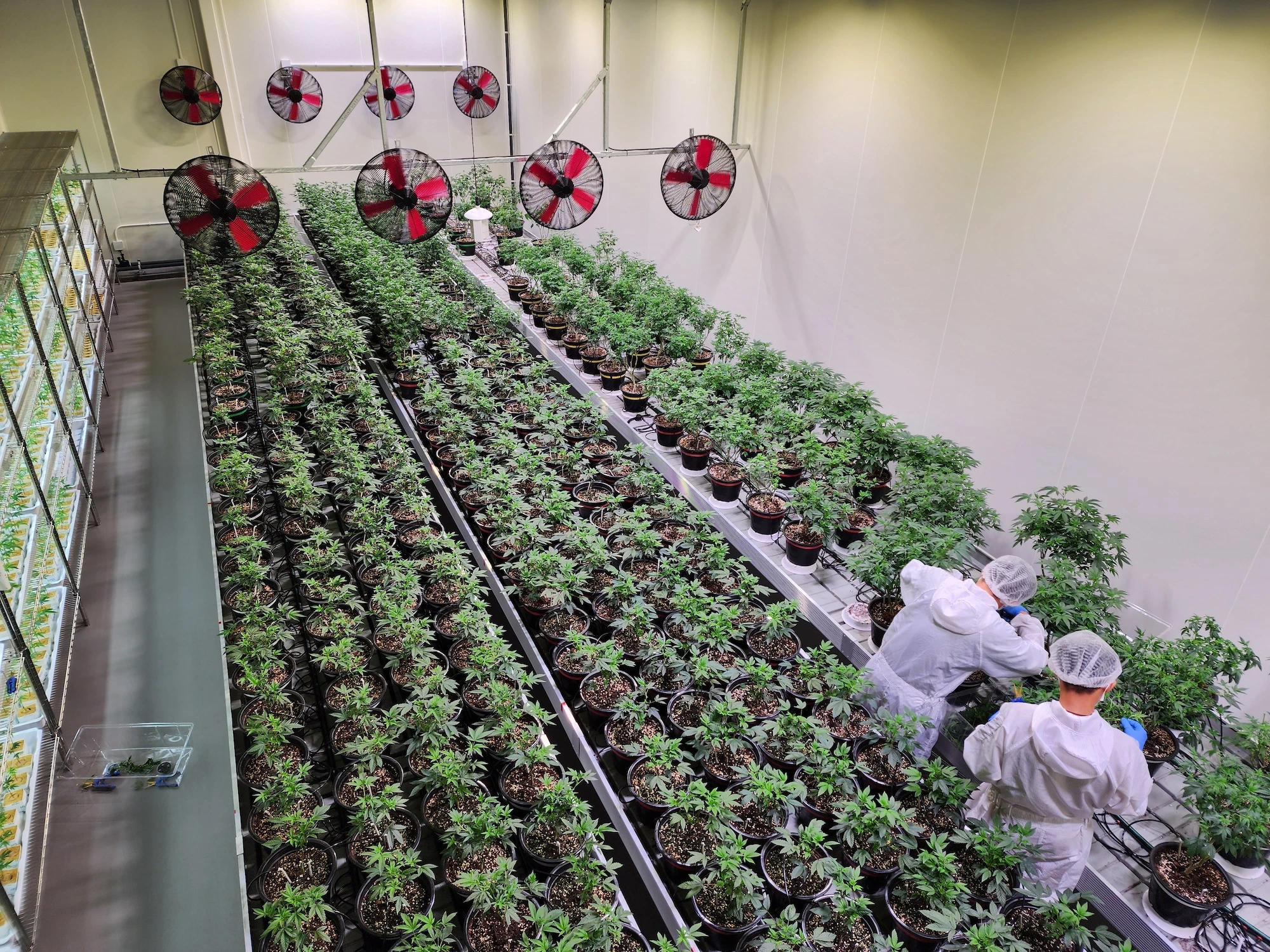
Commercial cultivation economics reward higher output from the same footprint. Under-canopy aims to "unlock yield that's already there" by delivering usable light into shaded bud sites below the canopy — turning more of the plant into harvestable, high-quality flower without expanding square footage. CannaCribs Consulting now recommends under-canopy lighting for all new facility installations where budget allows.
- More yield, same footprint: Illuminating lower bud sites unlocks additional harvestable biomass — higher grams per sq ft without expanding the facility
- Better bud quality: Light reaching lower branches converts popcorn buds into dense, A-grade nugs throughout the plant
- Full-plant photosynthesis: More uniform light distribution reduces stretch and produces sturdier, more desirable plant morphology
- Labor savings: Reduced or eliminated lollipopping/pruning because lower sites develop into viable flower
- Airflow and microclimate friendly: Slim, passively cooled bars don't block airflow — but measure temps/RH before and after install and adjust fans as needed
- Potential pest/disease reduction: Fewer dark, humid zones below the canopy make conditions less hospitable for some pests and pathogens
- TSR Grow study: ~20% yield increase and 27% enhancement in bud size
- California Lightworks Mega Drive at Harborside greenhouse: 29.84% increase in total dried trimmed flower and 11% rise in A-grade flowers
- Thrive Agritech research: substantial A-grade flower increase, improved cannabinoid and terpene profiles, 5% THC increase
Three core spec buckets to evaluate when comparing under-canopy fixtures:
- Wattage: Total power draw that impacts heat load and operating cost
- Spectrum: The spectral makeup (blue/green/red/far-red) and how it pairs with your top lighting
- Efficiency (µmol/J): A "miles-per-gallon" metric for how effectively a light converts electricity into usable photons. A fixture at 3 µmol/J is 50% more efficient than one at 2 µmol/J. Target ≥2.5 µmol/J; top models reach 3.0+.
The DesignLights Consortium (DLC) maintains Qualified Products Lists including a horticultural category (Hort QPL). Create a free account at designlights.org, click "Find Products" → "Hort QPL," then search any LED fixture.
What to look for on each listing:
- Reported vs tested photometric performance: If a manufacturer reports 2.7 µmol/J but testing shows 2.5, they are overstating efficiency. You want tested performance to meet or exceed reported claims.
- Spectrum breakdown: Review blue/green/red/far-red band distribution and confirm it fits your lighting strategy and top-light pairing
- Third-party vetting evidence: DLC listing signals both reliability screening and potential eligibility for utility rebate programs
Nate's guidance: be very cautious about buying a light that is not listed in the DLC — it means there is no third-party reporting confirming its actual efficiency or performance claims.
- Running too early: Don't use in veg or early flower — wasted energy. The ideal time is 14–21 days into flower, after the initial stretch
- Underestimating HVAC + humidity load: More power = more heat; full canopy increases transpiration rates. Ensure adequate cooling AND dehumidification capacity before install
- Bad placement: Bars should point upward, positioned 8–12 inches below the canopy leaves. Use adjustable stands. Poor angle dramatically reduces effectiveness
- Spectrum mismatch: Match spectrum to your overhead lights where possible to avoid conflicting signals to plant photoreceptors. Full-spectrum tops → full-spectrum under-canopy. Red-enhanced tops → red-dominant under-canopy can work
- Ignoring airflow validation: Monitor temperature and RH at the bottom of the canopy after install and adjust fans accordingly
There's no one-size-fits-all fixture — the best light depends on your operation, room design, and budget. Notable options as of mid-2025:
- Illuminar: Most powerful 4-foot under-canopy bar at 160W (most are 120W)
- California Light Works Mega Drive: Patented daisy-chain system — hundreds of fixtures, 120–480V flexibility
- FloraFlex: Highest efficiency at 3.3 µmol/J (at time of recording)
In some regions and programs, utility rebates have covered 100% of the cost of under-canopy lighting installations. Always check rebate eligibility through your utility provider and use DLC-listed fixtures to qualify. If you're growing cannabis commercially and trying to be as competitive as possible, under-canopy lighting is no longer optional — it's part of your competitive edge.
Work With Experts on Your Cannabis Lighting Strategy
The CannaCribs consulting team evaluates lighting strategies as part of full facility design — integrating fixture selection, PPFD modeling, HVACD load calculations, and energy efficiency planning into a single, defensible approach. Whether you're designing a new facility or optimizing an existing one, they can help you get under-canopy (and your entire lighting strategy) implemented correctly from day one.

Lighting strategy, energy rebate programs, and facility design requirements vary by state. CannaCribs Consulting offers market-specific guidance in:
Related


