
Vegetative Phase — Shape the Canopy and Set Up Yield
The vegetative phase is the bridge between propagation and flowering — and one of the most strategic stages for shaping your final yield and quality. During this period, plants shift their energy toward foliage and structural development, preparing for the reproductive demands of flowering. At CannaCribs Consulting, we focus on using the veg phase to promote uniformity, structure, and resilience across the entire crop.
Decisions made during vegetation — canopy height, branching structure, plant spacing, and environmental setpoints — directly determine what's possible in the flower room. Getting veg right means getting to harvest with a consistent, high-performing canopy. Getting it wrong means spending the entire flower cycle managing problems that were preventable.

Get the Cannabis Facility Build Guide Toolkit
Everything from this series in one downloadable pack — Excel calculators, checklists, and a printed quick-reference card. Built by the team behind CannaCribs Consulting.
- 📊 10-Tab Excel Workbook
- 💰 Financial Model Calculator
- 📍 Site Selection Scorecard
- 💧 Fertigation Dryback Log
- ✅ Commissioning Checklist
- 🔒 Compliance Readiness
- 📄 Quick Reference Card
Timing & Duration: How Long to Veg
The vegetative phase typically lasts between 7 and 21 days in commercial cannabis, with the right duration determined by a combination of cultivar behavior, facility design, and production goals — not a fixed schedule.
| Factor | Shorter Veg (7–10 days) | Longer Veg (14–21 days) |
|---|---|---|
| Ceiling height | Limited vertical space; multi-tier systems | Tall single-tier rooms with room to grow |
| Plant density | Higher density; shorter plants needed | Lower density; plants need to fill canopy space |
| Production goal | Faster room cycling; higher annual throughput | Bulking up plants; maximizing yield per plant |
| Cultivar behavior | Vigorous, fast-growing strains | Slower or compact genetics that need more time |
| Target metric | Grams per square meter per year (throughput) | Grams per watt or per plant (quality/density) |
There is no universally "correct" veg time — only the right veg time for your specific system, genetics, and targets. The most important variable is not duration but exit condition: plants should leave veg when they are at the desired height, have established uniform canopy structure, and have a root system that can support the water and nutrient demands of flowering.
Structural Development and Canopy Control
The primary goal of the veg stage is to develop strong plant architecture that supports heavy flowering later on. Canopy structure and plant morphology are most easily manipulated during vegetation — before the plant commits its energy to reproductive growth. CannaCribs uses this window to:
- Promote lateral growth to maximize the number of flowering bud sites per plant
- Even out canopy height across different strains or tables to ensure uniform light distribution in flower
- Improve airflow and light penetration paths through the canopy that will persist into flowering
On Topping
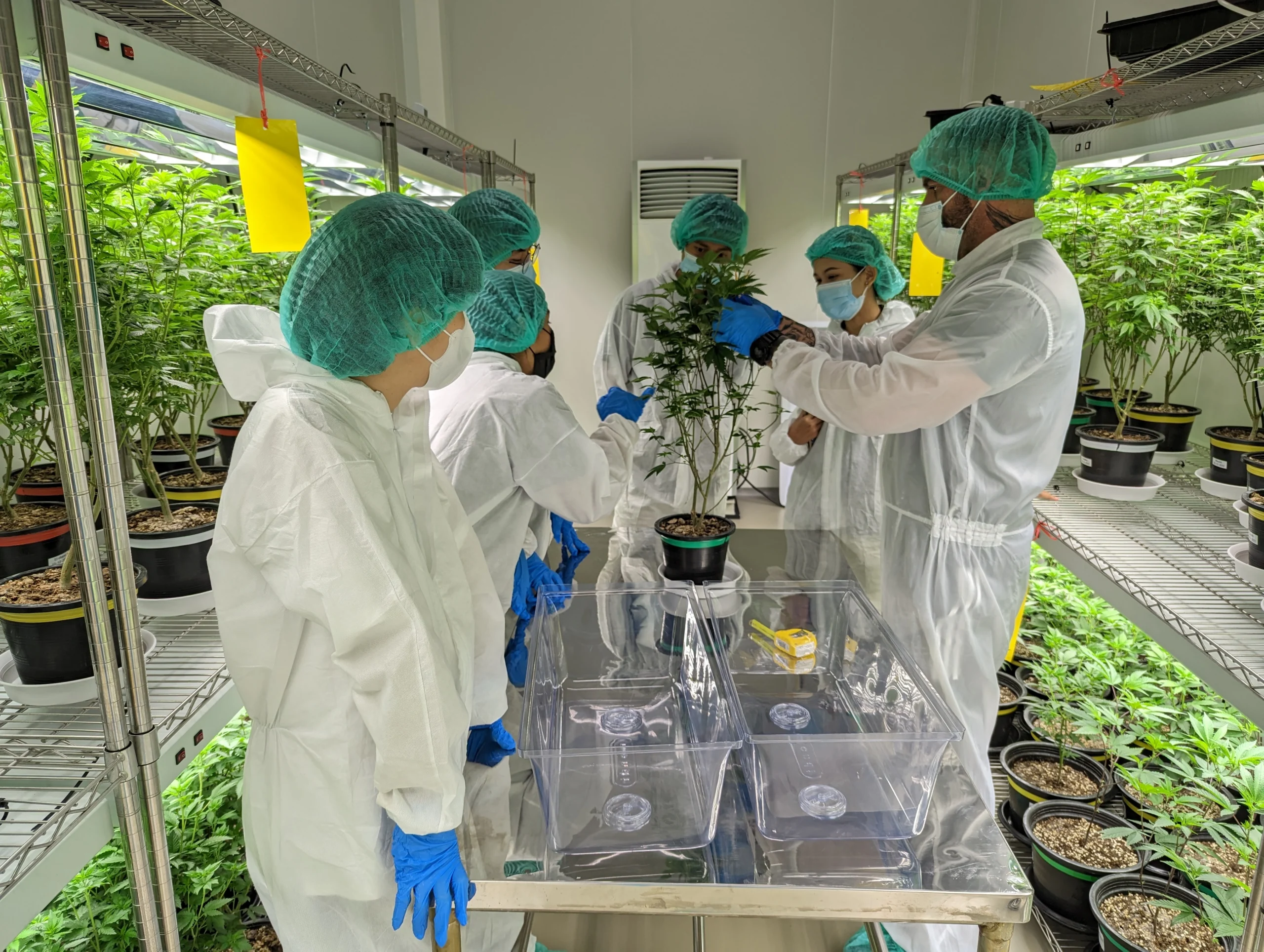
CannaCribs typically avoids topping unless it's specifically necessary — for example, when working under plant count restrictions where you need more bud sites per plant, or when trying to maximize canopy spread at lower plant densities. If topping is required, the vegetative phase is the correct time: plants are small and uniform, recovery is fast and predictable, and the resulting branching structure has time to develop properly before flower induction.
The key principle: any canopy manipulation technique should produce uniform results across the entire room. An inconsistently topped crop — where some plants are topped and others aren't, or different cultivars respond differently — creates canopy irregularities that ripple through the entire flowering cycle.
Growth Manipulation Techniques
Beyond physical training, the vegetative phase offers several non-invasive levers to influence plant morphology. These techniques work best when the facility's equipment and controls are already designed to support them:
Light Spectrum Adjustment
Higher blue light ratios (400–500 nm) reduce internodal stretch, producing more compact, bushy plants. Controllable LED fixtures with spectrum adjustment make this straightforward; fixed-spectrum fixtures cannot leverage this technique.
DIF (Day/Night Temperature Differential)
Managing the difference between day and night temperatures influences internodal spacing. A negative DIF (nights warmer than days) reduces stretch; a positive DIF (days warmer) promotes elongation. Effective with precise HVACD control systems.
Mild Drought Stress
Controlled dryback cycles slightly beyond the typical 30–50% target encourage root zone expansion and tighter internodal spacing. Requires real-time substrate moisture monitoring to avoid crossing into damaging stress territory.
Nutrient Ratio Adjustment
Fine-tuning the feeding program during veg — such as slightly reducing phosphorus relative to nitrogen — can promote more compact, balanced vegetative growth rather than the upward stretch that excess phosphorus can sometimes encourage.
Important caveat: these techniques are only effective and safe when paired with the right equipment, environmental controls, and monitoring tools. Attempting DIF without precise HVACD control, or applying drought stress without substrate sensors, introduces more risk than benefit. CannaCribs integrates these tools into facility design intentionally — so that the veg team has the means to execute them repeatably and safely.

Transitioning to the Flowering Room
Once a plant reaches the desired height with a robust, uniform canopy and an established root system, it's ready to transition into the flowering room. This is a key moment in the production cycle — one of the highest-risk points for stress, contamination, and uniformity loss.
At transplant, several things shift simultaneously:
- Photoperiod: 18+ hours in veg drops to 12 hours in flower, triggering reproductive hormonal changes within the first few days
- Plant spacing: density typically decreases as plants need more airflow and light distribution for developing flowers
- Irrigation strategy: water demand increases significantly as the canopy develops; P1/P2/P3 timing must be recalibrated
- Nutrient program: nitrogen emphasis shifts toward phosphorus and potassium as buds form
- Environmental setpoints: temperature and humidity targets adjust for the increased transpiration of a full canopy
The uniformity and health of veg plants at transplant is the single strongest predictor of harvest consistency. Uneven plants entering flower — different heights, different root development, different stress levels — produce uneven harvests. Every investment in proper veg management pays compound returns at harvest.
Download the Build Guide Toolkit
Financial model, setpoints reference, site scorecard, dryback log, commissioning checklist, and compliance readiness — all in one Excel workbook + Word quick-reference card.
- 🌡 Environmental Setpoints
- 💡 PPFD & DLI Calculator
- 🪴 Dry Room Sizing Tool
- 🌱 Clone KPI Tracker
- 🔒 Pre-Audit Checklist
Vegetative phase strategy — spacing, timing, canopy targets — varies by market, cultivar, and facility design. CannaCribs Consulting offers state-specific cultivation guidance in:
Q&A Section
Commercial cannabis veg cycles typically run 7–21 days depending on facility design, genetics, and production goals. There's no single correct answer — the right veg duration is the one that produces plants at your target height, canopy structure, and root development when they enter the flower room.
Multi-tier systems with limited vertical space typically veg for 7–10 days to keep plants compact. Single-tier rooms with more height may extend to 14–21 days to bulk up plants for maximum canopy fill. The key metric is the plant's exit condition, not the calendar duration.
CannaCribs typically recommends against topping unless it's specifically necessary — such as when plant count restrictions require more bud sites per plant, or when maximizing canopy spread at low planting densities. The added complexity, recovery time, and potential for uneven results often outweigh the benefits in high-throughput commercial settings.
When topping is warranted, the vegetative phase is the right time: plants are small, uniform, and recovery is faster and more predictable than topping during stretch. The most important factor is consistency — topping some plants and not others, or inconsistent cut placement, creates canopy irregularities that persist through flowering and affect harvest quality.
Standard vegetative phase environmental targets:
- Temperature: 24–26°C (75–79°F). Consistent daytime temperature; manage DIF with nighttime setpoints if internodal stretch control is a priority.
- Relative humidity: 50–65% RH. Higher humidity is acceptable in early veg when plants are small; reduce toward 55–60% as canopy develops.
- Photoperiod: 18 hours of light minimum (many facilities run 18/6 or 20/4). Must remain above 12 hours to prevent accidental flowering of photoperiod strains.
- PPFD: 200–600 µmol·m⁻²·s⁻¹ depending on plant size and veg duration targets. Increase gradually as plants establish.
- CO₂: 800–1,200 ppm during light periods enhances growth rate at higher light intensities.
Canopy unevenness during veg has several common causes:
- Uneven propagation: clones that entered veg at different heights or stages of development will maintain or amplify that size difference through the whole cycle
- Inconsistent irrigation or nutrition: plants in drier or lower-EC zones grow slower; those in wetter zones grow faster — this is why substrate moisture uniformity matters in veg
- Mixed cultivars without stage separation: different genetics have different growth rates; growing multiple cultivars in the same veg room without management creates a variable canopy
- Lighting hotspots or dead zones: PPFD variation across the veg room creates differential growth rates even with uniform genetics
- Overcrowding: plants shading each other during veg stretch toward light and develop taller, weaker stems
The solution to most canopy unevenness starts at propagation — uniform clone height entering veg prevents most downstream problems.
Related


