
Nutrients — Build a Flexible, Future-Proof Program
A strong nutrient program is the foundation of healthy, high-yielding cannabis plants. But there is no single "one-size-fits-all" solution — nutrient formulations and feeding strategies are highly dependent on grower preference, facility design, cultivation style, and market goals. The best nutrient programs are designed with flexibility as a core principle, not an afterthought.
At CannaCribs Consulting, we design nutrient strategies that give maximum adaptability — ensuring your facility can handle different cultivars, shifting market trends, or a change in lead grower without needing to overhaul infrastructure.

Get the Cannabis Facility Build Guide Toolkit
Everything from this series in one downloadable pack — Excel calculators, checklists, and a printed quick-reference card. Built by the team behind CannaCribs Consulting.
- 📊 10-Tab Excel Workbook
- 💰 Financial Model Calculator
- 📍 Site Selection Scorecard
- 💧 Fertigation Dryback Log
- ✅ Commissioning Checklist
- 🔒 Compliance Readiness
- 📄 Quick Reference Card
Key Macronutrients and What They Do
Drives vegetative growth — leaf development, stem structure, and chlorophyll production. Tapered off during late flowering to encourage ripening and terpene concentration.
Critical for root development, energy transfer (ATP), and flower/bud formation. Elevated during the flowering stage to support reproductive growth and bud density.
Regulates osmotic pressure, stomatal function, and enzyme activation. High demand throughout flowering — supports turgor, resin production, and overall plant resilience.
Essential for cell wall structure and root development. Deficiency causes tip burn and bud abnormalities. Maintained throughout all stages — especially in fast-growing environments.
The central atom of the chlorophyll molecule — essential for photosynthesis. Deficiency causes interveinal chlorosis (yellowing between leaf veins). Critical for light-intensive environments.
Iron, Manganese, Zinc, Copper, Boron, and others — required in trace amounts for enzymatic reactions, hormone production, and metabolic processes. pH stability is critical for availability.
Flexible Nutrient Formulation Options
Your facility should never be locked into a single fertilizer line. Supply chain disruptions, grower turnover, or shifts in cultivation philosophy can make a rigid nutrient program a liability. CannaCribs Consulting designs systems to accommodate three approaches — simultaneously, if needed:
Commercial Premixed Brands
Multiple brands accommodated. Easy onboarding, consistent ratios, and supplier flexibility. Switch brands without infrastructure changes if needed.
Raw Salt Custom Mixing
Full control over every macronutrient and micronutrient ratio. More technical, but gives growers complete flexibility to dial in recipes for specific genetics or market goals.
Boosters & Amendments
Specialty additives, enzymes, beneficials, and organic amendments applied on top of a base program. Supports cultivar-specific performance or quality-focused production goals.
Synthetic vs. Organic: Designing for Both
Many large-scale facilities use synthetic salt-based nutrients for their precision, consistency, and ease of automation. But there is a growing trend toward incorporating organic elements — biological inoculants, teas, and organic amendments — to improve terpene profiles, flavor complexity, and overall flower quality.
CannaCribs Consulting's philosophy is to build a system that can integrate both without compromise:
- Purely synthetic programs for maximum control, repeatability, and automation compatibility
- Hybrid programs that include organic inputs at strategic points in the cycle for enhanced secondary metabolite production
- Infrastructure flexibility to switch between or blend approaches without needing to retrofit the fertigation system
This matters because the cannabis market shifts. What's in demand today — maximum yield, boutique quality, specific terpene profiles — may not be what drives value in three years. A nutrient program that can pivot with market demands is a strategic asset.
Feeding Schedules & Growth Stage Specificity
Cannabis nutrient requirements change dramatically throughout the lifecycle. A single feeding recipe applied across all stages is a reliable path to mediocre results. The program must evolve alongside the plant.
| Growth Stage | EC Target | Key Nutrient Focus | Notes |
|---|---|---|---|
| Propagation / Clones | 0.5–1.0 mS/cm | Low N, Ca, micronutrients | Gentle environment; stress-free rooting. Avoid high EC during root development. |
| Vegetative | 1.2–2.0 mS/cm | N, Ca, Mg, micronutrients | Supports rapid growth and strong morphology. Higher ammonium ratio early in veg. |
| Early Flower / Stretch | 1.8–2.4 mS/cm | Transition: reducing N, building P & K | Gradual shift as plants transition to reproductive growth. Maintain Ca/Mg balance. |
| Peak Flowering | 2.2–2.8 mS/cm | P, K, Ca, Mg (high demand) | Maximum bud development phase. Monitor runoff EC closely to avoid salt buildup. |
| Ripening / Late Flower | 1.5–2.0 mS/cm | Reduced N; maintain K & micronutrients | Controlled N reduction enhances quality, terpene profile, and post-harvest characteristics. |

Deficiency Troubleshooting & Water Compatibility
Even the best nutrient plan encounters challenges in the field. Root zone conditions, water quality, substrate dynamics, and environmental factors all interact with your feeding program in ways that sometimes cause unexpected symptoms. Knowing how to read and respond to these signals is as important as the program itself.
pH Drift in the Root Zone
pH drifting above or below the optimal range (5.5–6.5 in hydro/coco, 6.0–7.0 in soil) locks out specific nutrient groups even when they're present in adequate concentrations. Regular input and runoff pH monitoring is essential.
Calcium or Magnesium Lockout
High potassium or ammonium can competitively block Ca and Mg uptake. Symptoms appear as tip burn (Ca deficiency) or interveinal yellowing (Mg deficiency). Adjusting ratios — not just adding more Ca or Mg — is usually the solution.
Micronutrient Deficiencies
Iron, manganese, and zinc deficiencies typically appear as yellowing in young leaves and growing tips. Often caused by pH issues rather than actual element deficiency. Confirm with runoff analysis before adjusting the recipe.
Salt Buildup in Substrates
Cumulative salt accumulation — visible as crusty substrate or rising runoff EC — reduces water uptake and stresses roots. Managed through appropriate leaching fraction (5–20% runoff) and periodic substrate EC checks.
Water Compatibility
Nutrient programs must be designed around your water source. Municipal water, well water, and surface water all carry variable mineral loads — calcium, magnesium, bicarbonates, sodium — that interact with your nutrient solution in unpredictable ways if not accounted for. CannaCribs Consulting ensures nutrients are compatible with your specific water chemistry, including:
- Bicarbonate buffering capacity that affects pH stability
- Background Ca and Mg levels that require recipe adjustments
- Sodium and chloride levels that can accumulate in substrates over time
- Seasonal variation in municipal supply that can shift baseline mineral composition
Starting with RO (reverse osmosis) water removes variable mineral content entirely, enabling precise nutrient dosing with consistent results year-round. Where RO is not practical, thorough water analysis and recipe calibration are essential first steps. Whether you're building in New York, New Jersey, Minnesota, or Virginia, water quality is a market-specific variable we evaluate early in every engagement.
Storage, Handling & Future-Proofing
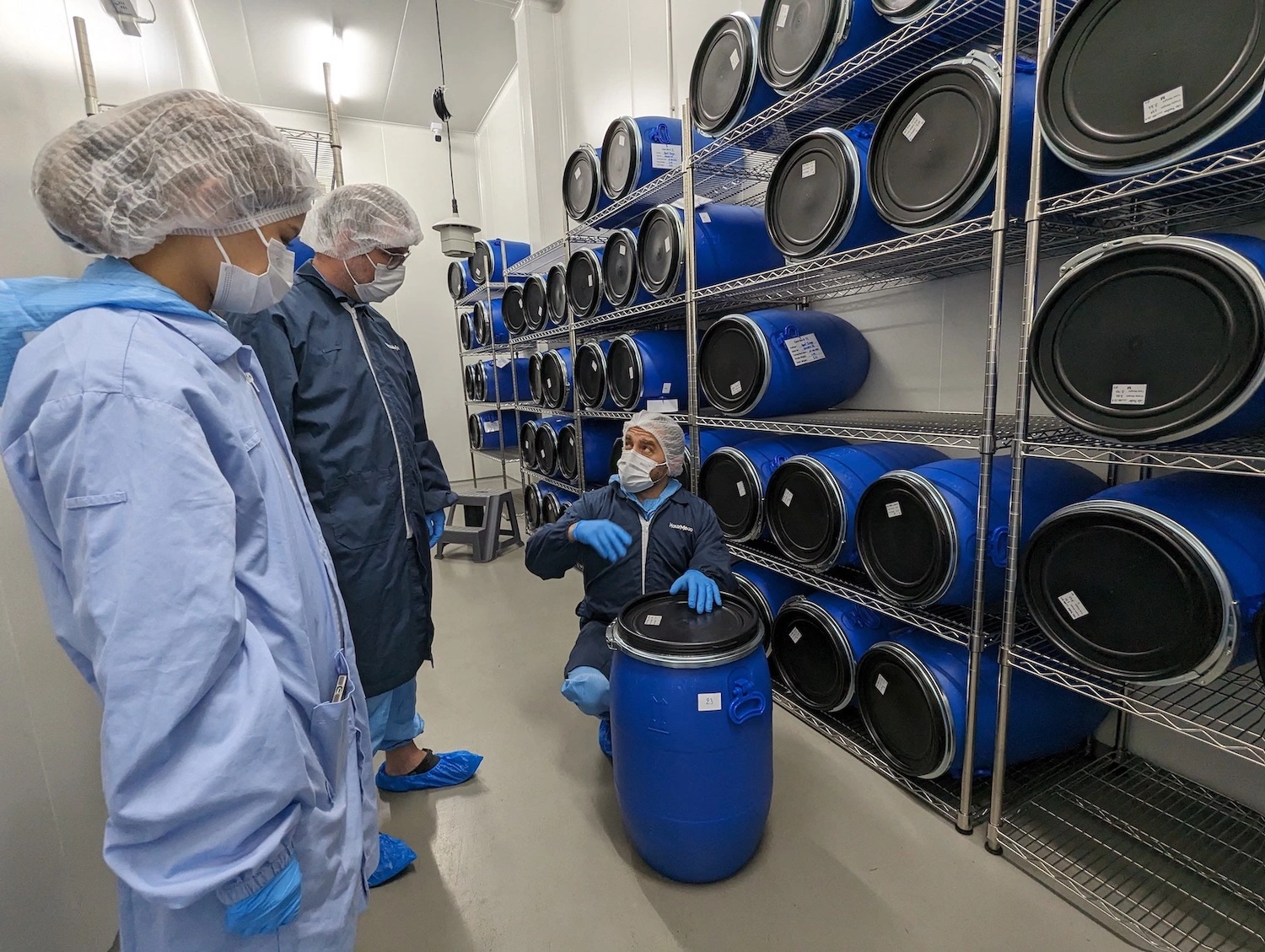
The nutrient program doesn't end with the recipe. Infrastructure for storage, handling, and long-term adaptability is a real part of facility design that is often underspecified — and becomes a problem when the operation wants to switch approaches, scale up, or accommodate a new lead grower.

Download the Build Guide Toolkit
Financial model, setpoints reference, site scorecard, dryback log, commissioning checklist, and compliance readiness — all in one Excel workbook + Word quick-reference card.
- 🌡 Environmental Setpoints
- 💡 PPFD & DLI Calculator
- 🪴 Dry Room Sizing Tool
- 🌱 Clone KPI Tracker
- 🔒 Pre-Audit Checklist
Water quality, approved inputs, and IPM-compatible nutrient programs vary by state regulatory framework. CannaCribs Consulting offers market-specific nutrient and cultivation strategy guidance in:

Q&A Section
Cannabis requires 17 essential nutrients across its lifecycle, with needs shifting significantly between stages:
- Propagation: Low EC (0.5–1.0 mS/cm), gentle calcium and micronutrient support for rooting — avoid high nitrogen
- Vegetative: Higher nitrogen for growth and structure, calcium and magnesium for strong roots and leaf development, moderate EC (1.2–2.0 mS/cm)
- Flowering: Gradual reduction of nitrogen, increase in phosphorus and potassium, sustained calcium and magnesium — EC 2.0–2.8 mS/cm at peak
- Ripening: Controlled nitrogen reduction enhances terpene production and post-harvest quality; EC steps back to 1.5–2.0 mS/cm
Most commercial-scale operations use synthetic salt-based nutrients as the foundation — they're precise, consistent, and automation-compatible. However, incorporating organic elements (biological inoculants, compost teas, amino acid-based boosters) at specific cycle points can meaningfully improve terpene complexity and flower quality.
The best commercial programs aren't purely synthetic or purely organic — they're designed to integrate both, with infrastructure that allows switching or blending without a system overhaul. The goal is maximum flexibility without sacrificing the precision that scale requires.
Most nutrient deficiencies in commercial cannabis are not caused by missing elements in the recipe — they're caused by pH or EC conditions that prevent existing elements from being absorbed. The most common causes:
- pH out of range: Different nutrients become unavailable at different pH levels. In hydro/coco, pH above 6.5 commonly locks out iron and manganese; below 5.5, calcium and magnesium become limited.
- Elemental competition: High potassium can block calcium and magnesium uptake; excess calcium can compete with potassium. Ratio management matters as much as absolute concentrations.
- Salt buildup: Accumulated salts in the substrate increase osmotic pressure and reduce water/nutrient uptake, mimicking deficiency symptoms even when the recipe is correct.
- Water quality mismatch: Background minerals in well or municipal water can interfere with nutrient ratios if the program wasn't calibrated against a water analysis.
Supply chain disruptions, formulation changes, price increases, and grower preference shifts all create situations where a single-brand dependency becomes an operational problem. A facility locked into one nutrient line has no fallback if that brand becomes unavailable, changes its formula, or proves incompatible with a new cultivar or cultivation approach.
Beyond supply risk, different cultivars often respond differently to different nutrient formulations. What works for one genetic may not be optimal for another. Flexibility means your facility can always run its best program — not just the one it was originally built around.
Related


GrowersHouse stocks a comprehensive selection of professional nutrients, including GH private-label brands and top commercial lines: